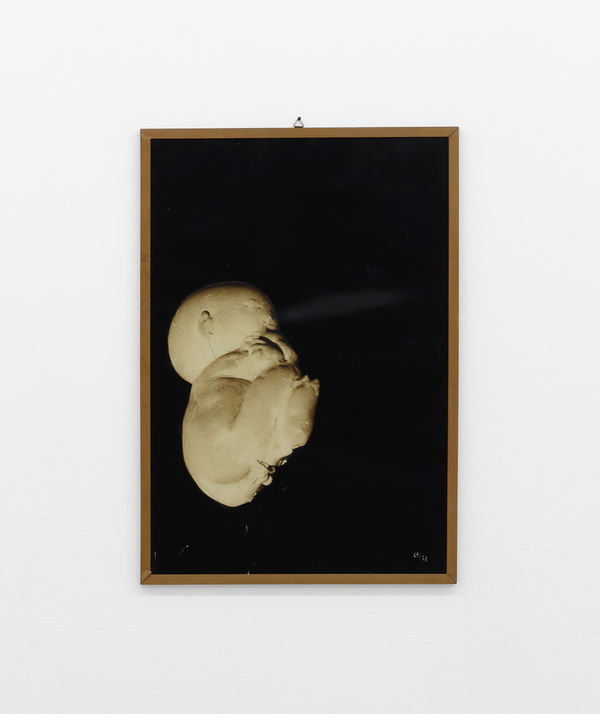
An Infinite Fable: Maria Lai

Opening
Thursday, 19.02 at 6 – 8 PM
Maria Lai – An Infinite Fable
Curated by Nora Iosia
In collaboration with Studio Stefania Miscetti
"Like poetry, music, visual art is artifice that builds bridges over reality. It help us cross through life."
– Maria Lai
An Infinite Fable was the title that Maria Lai chose herself to give to a memorable solo exhibition at Stefania Miscetti Gallery in 1994. At Belenius gallery we wish to make a tribute to the Sardinian artist’s work by using precisely one of her linguistic formulas, which represents the most profound yet tangible keys to interpreting her art world.
In this focus the gallery present some historical works by the artist who passed away in 2013. The selected works are part of significant series that remained as constants in Lai’s artistic practice.
The sewn books are rare pieces that marked her production in the 1980s. Maria’s books and pages are apparently not readable since language becomes a tangle of thread difficult to unravel and decode, but at the same time they bring us into new possibilities of reading comparable to the immediate language of poetry and musical rhythm, because they are an abstract body of the huge power of gesture and imagination.
Lai’s art is nourished by fables and legends from her prehistoric land, Sardinia, through which she questions the making of art, she looks at the mystery and play in art with wonder, embracing the archetypes in a sort of reconciliation.
Fable of Maria Pietra rewritten by Maria Lai (in Federica Di Castro e Maria Lai, La Pietra e la Paura, ed Duchamp).
Maria Pietra is the character in Salvatore Cambosu’s story, Cuore mio: a mother who accepts becoming stone to save her child from death.
In this interpretation she becomes a common woman who, before being a mother, is endowed with unknown and forbidden powers.
She is afraid of them, like every poet.
Maria Pietra’s powers could not be used for practical purposes, not even for a great love like that of a mother for her sick child. Maria Pietra is a baker and with words she can enchant and capture all creatures, but she must learn to use her powers.
When her child in the delirium of fever asks to play with the animals of the forest, the mother defies her fear and goes to the distant forest, one by one, deer, hares and doves that arrive and move.
Maria Pietra, caught up in the delirium of her child, will see him die, but, mad with grief, she rediscovers her creativity.
The art that is born outside all logic accomplishes the miracle: kneading flour with her tears and making many bread children, she brings her child back to life, to play with the animals of the resurrected forest.
*Metaphorical images*
*Maria Pietra*: the artist
*Paura* (Fear): generates creativity
*Pietra* (Stone): is art
*Bambino* (Child): the malaise of the world
*Gli animali del bosco* (The animals of the forest): toys for children, works of art for adults.
Maria Pietra’s canvas belongs to a poetic vision that, from the legend Cuore mio by writer Salvatore Cambosu, turns in instant language of images sewn on cotton fabric. The artist created in 90s a series of vertical works in this legend shown at Miscetti gallery in Rome and Belenius gallery presents one in which the protagonists are the forest animals that appear as symbols of rebirth and play.
Wall – Homage to Nivola is an important and rare sculpture and a kind of tribute by Maria Lai to her friend Sardinian artist Costantino Nivola, with whom she was connected for years by affinity and artistic dialogue. This work represents the Maria Lai’s language of sculpture and brings us to the monumental works that the artist made for her hometown Ulassai, defined as her Land Art.
Art must be like bread that rises and must be food for everyone: this is how Maria Lai’s Land Art and La Stazione dell’arte (The Station of Art), Ulassai Museum was born. The Station of Art, founded by the artist in the mountains battered by the sea breeze of Ulassai remains today a place for every one, and collects her cultural patrimony and keeps it intact for us today.
“(…) wood and string, bread puppets, books, and sewn maps are the discovery of the symbolic and ritual connection between the aesthetic and the everyday life, fables are the rediscovery of childhood as a place of the soul, as a mental disposition; the sense of mystery, of amused wonder at things, accompanies us even as adults. (…) In Maria Lai's tales, these archetypes are continually enriched by a technical and artisanal dimension that, only apparently simple and didactic, leads to increasingly complex interpretations. Arachne's thread and Ariadne's thread of her research, sewing takes on an inescapable metanarrative meaning: by telling, it tells itself. Constructing itself as writing, as image, joining signs and meanings the thread creates a story within the story.” – Gianni Murtas
The Roman period and the collaborations as a gallerist with Maria Lai
By Stefania Miscetti
Maria Lai has been a constant presence in my life, my conduit to art. She was the one who taught me that art is the only arena, which must be inhabited with rigor, discipline, rhythm, continuity of action, and concentration of thought.
In 1991, two years after opening STUDIO STEFANIA MISCETTI, my gallery in Rome, I asked her to do a new exhibition project, the first in a long series of shows and initiatives. There was no need for words. She was very generous and immediately told me she wanted to do a performance work, La leggenda di Maria Pietra (The Legend of Mary Stone). We began work on the theatrical action, which consisted of the unrolling from above of some of her sewn canvases thronging with woodland animals, the arranging of ceramic Sassi (Stones) and bread children on an old piece of wood, and the screening of a video with music by Giuseppe Scotese. We were helped by a group of young students who were guests at Maria’s studio, just as I had been. I had known her since 1970, when, as a young university student studying architecture, I first met this petite woman with a fiercely penetrating gaze, who offered a small group some space in her studio in Rome.
She actually offered a lot more than that, with her assiduous but never intrusive visits, always with an idea, a line of thought, often with a book that served as a way into art history and cultural life. Dinner invitations were frequent. They were an opportunity to watch Carmelo Bene, a controversial, well-known actor and writer, on TV, whom Maria admired greatly though they were very different; or to talk about an exhibition, or perhaps an experimental theater show by Claudio Remondi and Riccardo Caporossi, with their writing in images and their work with and on the body. Maria was a great storyteller, who would recount the legends and fairy tales of her native Sardinia for hours. She made us witnesses of her creative practice, weaving a narrative that invited us to converse, to participate empathically in her works. At the same time, she affirmed the need for silence, for the isolation that leads to the creation of art, though this was always directed toward a fruitful encounter with the work and ideas of others.
She instilled in us a sense of duty to produce something every day, each according to their own abilities, to give back what is gifted to us in abundance from the outside world.
They were years of exchanges, which continued even when we started working, following her exhibitions, including the Venice Biennale in 1978. From then on, until she passed, a thread of listening, witnessing, admiration, and friendship ran through my relationship with Maria.
In 1994 we presented her second important gallery show. Besides the canvases of the 1991 performance, she also showed around a dozen sewn books. Just two days before the opening, Maria decided to produce a large door frame on the arch of the entrance corridor—an unexpected and spontaneous tribute to the space, built in just one afternoon with help from me and two others.
Until then the art world had been somewhat mistrustful of this overly independent, unconventional artist who had devoted so much time to the theater, to workshops, and in-situ works in Sardinia, and who stubbornly continued to animate and be animated by fairy tales, legends, and games.
Play was the focus of the 2005 exhibition A portata di mano. In addition to her sewn canvases, we presented four decks of playing cards, which she invented to stimulate questions about themes in art. At the private view everyone vied to play with Maria, who quietly juggled curators, critics, friends, and former pupils like me and Francesco Proia, who was one of our initial group of students, and the only person admitted to the hanging of the show and the arrangement of the cards on the walls. The exhibition set-up followed the same script over the years: Maria asked, listened… and then did exactly what she had had in mind from the start!
The last exhibition in 2018 was my heartfelt tribute to her long and prolific artistic output. During the set-up I often asked myself what Maria would have thought of it… There was one thing that she would certainly have been happy with: all her works, from the 50s through to her final pieces, were bound together, as testimony to her everyday practice, by the screening on the large back wall of the gallery, of Legare collegare, Tonino Casula’s documentary about Legarsi alla montagna.
My closeness to Maria, and the good fortune of having been part of this memorable performance, were vital experiences for me both personally and professionally. They taught me to believe in the importance of poetic vision irrespective of the commodification and categorization of art. And they showed me how, from a small spark, and in a spirit of collaboration and shared endeavor, it is possible to realize undertakings of an unusual magnitude.
Maria Lai was born in Ulassai, in the province of Nuoro, in 1919. After completing a teacher training diploma she moves to Rome in order to pursue her studies at art school; from 1943 to 1945 she works under the tutelage of Arturo Martini at the Venice Academy of Fine Arts.
During the 1950s and 1960s – a period marked by a connection to literature that will prove fundamental, most notably with Salvatore Cambosu and Giuseppe Dessì, who introduce her to the world of folk legends and traditions – she primarily focuses on line drawing and the painting of subjects related to the world of Sardinia and begins working on bread sculptures. This experimentation with materials and techniques continues into the 1970s, culminating in the creation of looms, geographies and books, particularly memorable among which is the Libro scalpo (Scalped Book) presented in Venice in 1978. During the 1980s, as well as creating her most important geographies and cosmogonies, she dedicates herself to local-level action and performances in Sardinia; among these Legarsi alla montagna (1981) inspired by a Sardinian folktale, the first example of relational art in Italy; of particular note is the recovery of the Ulassai public bathhouse in 1988, made possible thanks to the involvement of Costantino Nivola, Guido Strazza and Luigi Veronesi.
The 1990s are characterised by projects such as Su barca di carta m’imbarco (On a paper boat I’m setting sail, Atelier sul mare di Messina, 1997), Il tempo dell’Arte (The Time of Art, Su Logu de s’Iscultura di Tortolì, 1999) and Olio di parole (The Oil of Words, Museum of Oil of Sabina, 1999). In the following years, as well as continuing her research into the use of ceramics, wood, iron, cement and other synthetic materials, she also works in theatre, writes essays on the role of the artist and the reading of works of art, and works with schools. In 2004 she received an Honorary Degree in Literature from the University of Cagliari, and in 2011 the Premio Camera dei Deputati (Chamber of Deputies Award).
In 2024 – 25, a new retrospective exhibition of Maria Lai’s work was presented at Magazzino Italian Art, New York. In 2019, the first major retrospective dedicated to the artist was held at MAXXI, Rome. Her works were exhibited at Palazzo Pitti, Uffizi Galleries, Florence, in 2018, and at the 57th Venice Biennale in 2017. In 2011, her work Orme di Leggi was selected as a symbolic piece and installed in the Italian Parliament to mark the 150th anniversary of Italy’s unification.
Among the many exhibitions in which she took part, the following deserve particular mention: Ricucire il mondo (Restitching the World, Nuoro, Cagliari, and Ulassai, 2014); L’arte ci prende per mano. 100 opere di Maria Lai dal 1942 al 2011 (Art Takes Us by the Hand, MUSMA, 2014); Italics. Italian Art between Revolution and Tradition: 1968 – 2008 (Museum of Contemporary Art, Chicago, 2008; Palazzo Grassi, 2003); I libri di Maria Lai (GNAM, 2003); Come un gioco (MAN, 2002); Inventare altri spazi (Scuderie di Palazzo Ruspoli, 1994); La natura dell’artificio(AAM, 1994); A matita (Galleria Comunale di Cagliari, 1988); Materializzazione del linguaggio (Venice Biennale, 1978), on the invitation of Mirella Bentivoglio; the first exhibition of looms at the Schneider Gallery (1971); and her first solo exhibition of drawings, curated by Marcello Venturoli at the Galleria dell’Obelisco (1957).
The largest collection of Maria Lai’s works is held at the Stazione dell’Arte, Ulassai, a foundation inaugurated by the artist herself in 2005. Her work has been acquired by numerous Italian and international collections, including the Civic Museums and the National Picture Gallery of Cagliari; the Museum of Art of the Province of Nuoro; the National Gallery of Modern Art and the Rome Quadriennale; the Museum of Modern and Contemporary Art of Trento and Rovereto; the Museum of Contemporary Sculpture in Matera; the Pinacoteca of Ancona; the National Library of Florence; the Donnaregina Museum of Contemporary Art in Naples; the Centre Pompidou in Paris; and the Olnick–Spanu Collection in New York.
Maria Lai died in 2013.
Photo by Viktor Sjödin